What Should African Hospitality Feel Like?


There is a particular kind of restaurant experience we have come to associate with “good hospitality.”
The waiter speaks softly. The table is perfectly set. Everyone seems to know exactly what to do. Service moves at a certain pace. The language is polished. The room is quiet enough to hear your conversation.
None of these things are bad.
In fact, there is a lot African restaurants can learn from well-run hospitality businesses around the world: good training, consistency, menu knowledge, cleanliness, reservation systems, clear communication, timing, complaint handling and attention to detail.
But somewhere along the way, we started confusing professionalism with imitation.
As though, for an African restaurant to be considered excellent, its hospitality has to look and sound a certain way.
Standards can travel.
A standard is a standard.
A guest should not have to wait an unreasonable amount of time for food because the restaurant is “laid-back”. A server should know what is on the menu. Tables should be clean. Staff should know how to communicate when something goes wrong.
These are not Western values.
They are the foundations of a functioning hospitality business.
My professional training taught me a lot about this: discipline, repetition, technique, responsibility and systems. The importance of doing something well more than once.
But training also made me think more deeply about the difference between learning a system and adopting someone else’s idea of what hospitality should look like.
The system can travel. The expression does not have to.
Warmth is not a substitute for standards.
African hospitality is often described through warmth.
We are generous. We feed people. We insist they have more. We ask if they have eaten. We make room at the table.
These things matter.
But warmth alone does not make a restaurant good.
A smiling server cannot fix a two-hour wait.
Generosity cannot compensate for poor training.
A beautiful story about family cannot make up for inconsistent food.
And telling guests to “be patient” is not a hospitality strategy.
If we are serious about building restaurants that can compete locally and internationally, then we have to be willing to talk about the less romantic parts of hospitality too:
Training. Costing. Staffing. Timing. Reservations. Service standards. Communication. Consistency. Systems.
The challenge is not choosing between warmth and professionalism.
It is learning how to build systems that protect the warmth rather than depend on it.
I learnt about hospitality before I knew to call it that
Some of my earliest ideas about hospitality came from my grandmother’s table.
There was intention in how she prepared food, how the table was laid, how people were served and how closely she paid attention to whether everyone had eaten.
Even something as ordinary as tea and biscuits could become a small ritual.
Looking back, I realise that hospitality was not simply about feeding people.
It was about noticing.
Who had arrived.
What they liked.
Whether they were comfortable.
Whether they had enough.
Whether something needed to be done without being asked.
That kind of attention is deeply familiar across many African homes. But when you move from a home to a restaurant, you cannot rely on instinct alone.
You may have 40 guests instead of four. You have different servers, different shifts, different levels of experience and different pressures in the kitchen.
The owner cannot personally notice everything.
That is where systems become important.
The goal is not to remove the humanity from hospitality. It is to make good hospitality repeatable.
So, what should African hospitality feel like?
I don’t think there is one answer.
African hospitality is not one thing.
Lagos does not feel like Lomé. Accra does not feel like Dakar. Our histories, languages, food cultures and social habits shape how we welcome people.
And that is precisely why I am interested in the question.
For me, five things should sit alongside each other:
Warmth: People should feel genuinely welcomed, enough to want to come back.
Standards: Good intentions should be supported by consistency, cleanliness, timing and systems.
Knowledge: People serving food should understand what they are serving. Not just the ingredients, but the story, technique or context when that matters.
Anticipation: Good hospitality notices what a guest might need before they have to ask.
Cultural confidence: We should not have to make our restaurants feel European or American before we believe they are professional.
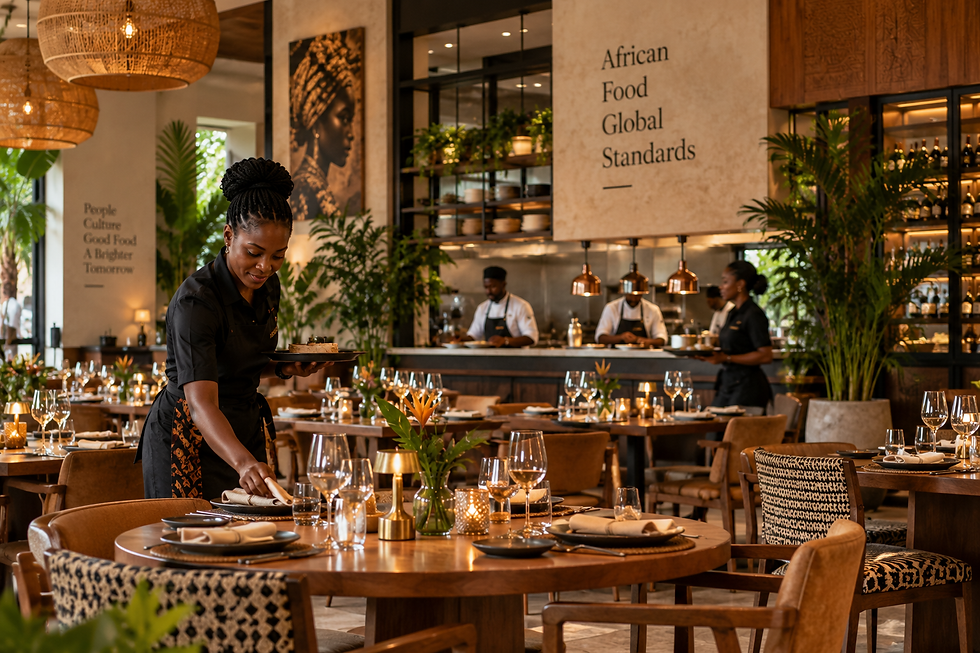
An African restaurant can be highly organised and deeply generous.
It can be contemporary without becoming anonymous.
It can have excellent service without losing its personality.
It can meet international standards without treating international cultures as the standard of cultural expression.
The restaurant is the whole experience
We sometimes talk about restaurants as though the food is the only thing being judged.
It isn’t.
The guest experiences the reservation, the welcome, the room, the cleanliness, the music, the menu, the staff, the communication, the wait and the food.
They notice how a mistake is handled.
They notice how they are thanked when they leave.
All of it becomes part of the memory.
This is why hospitality is not just about being nice.
It is a business discipline.
The table tells you a lot about the business behind it.
Whether the team is trained.
Whether the systems work.
Whether the owners understand their customers.
Whether the restaurant knows what it wants to be.
Whether its culture has been translated into an experience that people can actually feel.
And sometimes, you can tell when a restaurant is trying very hard to look like somebody else’s idea of excellence.
Excellence does not have to sound the same everywhere
I am not interested in arguing that African hospitality is better than Western hospitality. That would simply create another hierarchy.
I am interested in something more useful.
What happens when we take the best lessons from global hospitality and build from our own cultural understanding of welcome?
What does that produce?
That, to me, is a more interesting future for African hospitality.
We do not need to choose between identity and excellence.
We need to become confident enough to build systems around both.
Because the African restaurants that compete globally tomorrow may not be the ones that become the most Western.
They may be the ones that become excellent without becoming generic.
And perhaps the better question is not:
What does good hospitality look like?
It is:
What should it feel like to sit at our table?


Comments